Impact bi-fold doors
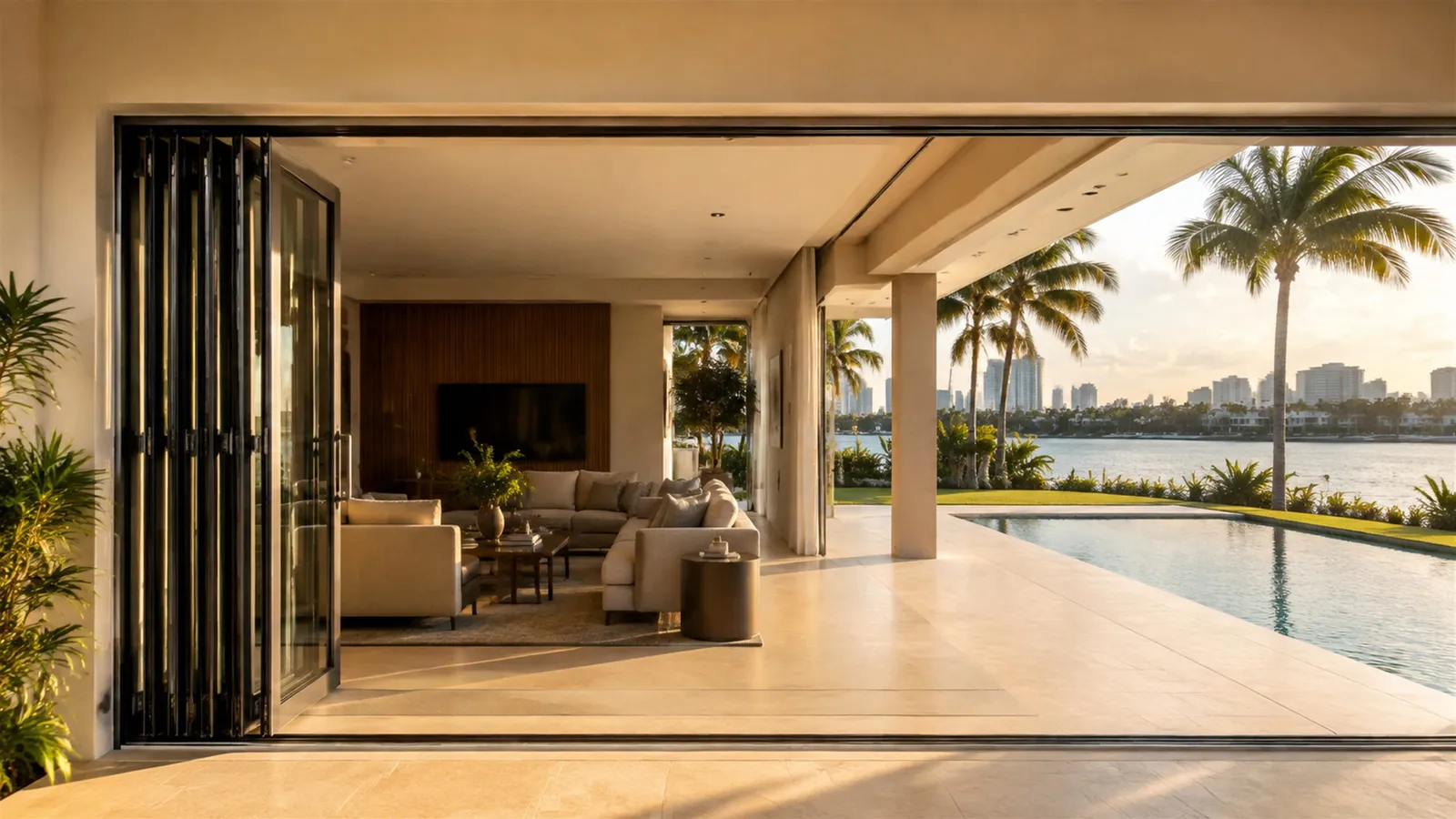
Panels that fold and stack to one side, clearing about ninety percent of the opening.
Specifications
How it works
- Operation
- Panels fold in pairs and stack to one side
- The stack stays visible at the edge of the opening. That is the trade against a pocket door, and it is also why a bi-fold does not need building work.
- Clear opening
- Around ninety percent
- Nearly the whole thing, against roughly half for a sliding door. This is the reason people buy them.
- Scale
- Up to sixteen panels in one system
- Eight in each direction, spanning a very wide opening. Most homes use far fewer; the ceiling is high enough that the opening decides, not the product.
- Construction work
- Usually none beyond the opening itself
- No wall cavity is needed, which is what separates this from a pocket system and keeps it a door job rather than a remodel.
What to ask for
- Impact rating
- Large Missile — TAS 201, 202 and 203
- The Miami-Dade test protocol.
- Design pressure (DP)
- On the NOA, per model and per size
- The pressure the unit is approved to take.
- Product approval
- Miami-Dade Notice of Acceptance
- The document that makes the unit legal here.
The exact figures come from the Notice of Acceptance of your model at your size. We give you yours with the quote.
Product approvals
1 product approval on file for this type: the number, the revision and the expiry of each, with the document, filed by manufacturer.
Bi-fold against the alternatives
Clears about ninety percent of the opening, against roughly half for a slider
No wall cavity required, unlike a pocket system
Scales to very wide openings without changing the approach
Impact rated, so an open-front elevation is still code compliant
Suits restaurant and bar frontages as well as homes
Costs less and disrupts less than the equivalent pocket door
About bi-fold doors
Bi-fold or pocket?
A bi-fold stacks its panels visibly at one side, opens around ninety percent, and needs no building work. A pocket system disappears into the wall completely, opens essentially one hundred percent, costs more, and requires the receiving wall to be non-structural or redesigned. If the wall cannot take a cavity, the decision is already made.
Where does the stack go?
To one side, or split to both, and you choose. Look at where furniture, a wall return or a walkway is before you decide, because a stack in the wrong place is the one thing people regret.
Is it as weathertight as a slider?
A well-specified impact bi-fold seals properly, and there are simply more joints in it than in a two-panel slider. On an exposed elevation that is worth talking about honestly rather than glossing over.
Other types in the same line
If this is not the one you were after, these are the ones next to it.
Get a price for your openings
Every quote is measured. That is the only way the numbers mean anything.
Get a free estimate